



From “Construction 2.0” to the “Year of AI”: Innovations Inspired by S960
With the Construction Industry Council (CIC) declaring 2026 as the “Year of Artificial Intelligence,” the industry is now moving from the era of “Construction 2.0” toward a more AI‑driven “Construction 3.0.” Looking back at this journey, we must acknowledge the Development Bureau’s long‑standing efforts in promoting construction technology (ConTech). To be honest, I was skeptical at first and wondered, “Will this be another empty slogan? Will people actually follow through after the speeches?”
But reality has proven otherwise. In recent years, the industry has indeed undergone a genuine cultural transformation. Government departments—once stereotyped as conservative—have become active adopters of new technologies, guiding the industry toward innovation through various innovation funding schemes. From Building Information Modelling (BIM) and the Smart Site Safety System (SSSS), to Modular Integrated Construction (MiC), and now the latest applications of drones and robotics, these changes are truly happening.
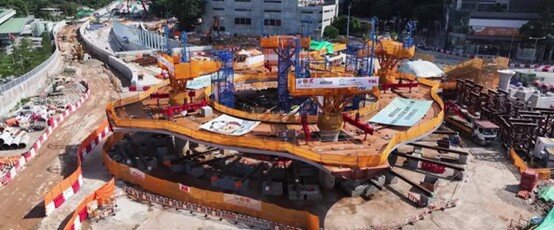
A recent example is the “Fanling North New Development Area, Phase 1: Fanling Bypass Eastern Section (Contract No. ND/2019/04)” project—led by the Civil Engineering and Development Department (CEDD) and constructed by Chun Wo—which has received multiple recognitions across the industry. It stands as a milestone of this ongoing transformation.
Fanling Bypass Eastern Section: Opening a Path for Innovation Within Contract Constraints
The Fanling Bypass Eastern Section is a key connector in the transport network of the Northern Metropolis. The project team boldly adopted multiple “world‑first” and “Hong Kong’s largest/first” applications, including:
- The world’s first S960 ultra‑high‑strength steel pedestrian footbridge;
- Hong Kong’s first international‑standard extreme sports skatepark;
- Hong Kong’s highest‑load‑capacity MiC lift
This success is the result of collaboration among CEDD, AECOM, The Hong Kong Polytechnic University, and Chun Wo. Each party played an essential role. I must highlight one crucial point: without CEDD’s proactive leadership, none of this could have happened.
Why? Because engineering contracts are naturally conservative. For safety, environmental protection, and risk management, contracts typically favour “well‑proven” technologies and materials. This inherent conservatism often conflicts with innovation. However, CEDD demonstrated exceptional foresight and courage—after thorough risk assessments and with sufficient supporting data—to break through traditional boundaries and choose the innovative path. Their determination is what made the application of S960 possible.
Innovation Comes With a Cost — Society Must Allow Room for Trial and Error
While celebrating these achievements, we must also deliver an important message: innovation always carries risks. When introducing a new technology to Hong Kong, what if it does not work well? What if it fails? Furthermore, innovation often means that the initial phases may require more time and more resources.
If society refuses to give government departments and industry stakeholders the space to experiment—if failure is intolerable—then successful cases will never emerge. We cannot only admire the glamour of results while ignoring the countless attempts, adjustments, and setbacks behind them.
For the industry to progress, the community must allow room for trial and error, accepting the uncertainties and fluctuations that come with innovation.
Building Momentum for the Future of Innovation
The application of S960 represents a major breakthrough in “hard” engineering technology, but improvements in “soft” capabilities are equally important. Encouragingly, government departments have also shown strong determination in advancing digitalisation.
For example, the Drainage Services Department (DSD) is developing a centralised management platform to enable genuine paperless communication among clients, consultants, and contractors. This aligns with the philosophy behind our own Mattex platform: the goal is not simply to “scan documents into a computer,” but to re‑engineer management processes to enhance efficiency.
From S960, to paperless workflows, to the broader adoption of AI—there is no doubt that innovation is the future of the construction industry. We will continue the pioneering spirit demonstrated in the Fanling Bypass project, boldly integrating new ideas into engineering practice and forging a new chapter of innovation alongside the industry.
As for the future—how we transition from today’s foundation into the AI era and harness artificial intelligence to reshape the construction sector—this will be the next major topic we explore.

2026-03-02
By Ir Dr. Pang Yat Bond, Derrick, JP
Chief Executive Officer
BSc, MEng, MBA, PhD, PE(US), MICE, MHKIE
Tags:


Leave your comment